From Scheduled Broadcast to the Streaming Queue
From scheduled broadcast to the streaming queue, see how a family’s viewing habits change as saved titles, recommendations and shared choices shape what gets watched.

At half past seven, Mara’s family has finished supper, but the nature programme they had planned to watch is already under way. The missed opening is not just a matter of timing: it exposes how a broadcaster’s lineup once supplied the evening’s order, while a streaming queue brings a new problem into view—how to choose among titles gathered for different people.
What did a television lineup decide for viewers?
Imagine Mara, her partner and their school-age child sharing one television in a rented flat. Before they use a streaming service, they rely on a fictional local broadcaster’s evening lineup: a nature programme follows the news, then a comedy. The broadcaster has selected the sequence; the household decides whether to join it.
A printed TV guide or an on-screen programme listing made that sequence visible. Viewers could see what came next and organise the evening around familiar slots. A video recorder offered another option, but recording required the right equipment and some advance planning.
The lineup also supplied a common reference point. Family members could expect the same programme to be on the channel at the same point in the evening, even if interruptions meant someone joined late. That shared structure was part of the television experience, not simply a technical limit.
How does a streaming queue change the household’s choices?
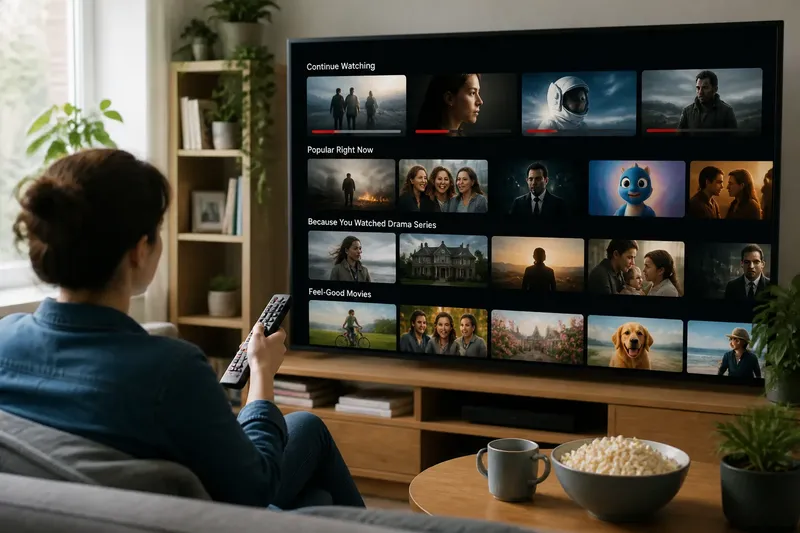
Now imagine the same family opening a streaming service. Mara saves the nature programme to a queue, her partner adds a comedy, and their child asks for a familiar animated film. The queue is no longer a ready-made sequence from one broadcaster; it is a pile of household intentions.
This changes the work of choosing. The family can sort titles by mood, by who wants to watch, or by whether everyone is in the room. A queue is a little like a shopping basket: it holds possibilities, but it does not decide which one belongs in the evening.
Nor does a saved title necessarily remain available indefinitely. Catalogues and account features vary, so a queue is best understood as a marker of interest rather than ownership of a programme. The service’s listing and terms determine what can be watched and for how long.
How can a family turn a crowded queue into a decision?
Say Mara opens the queue and sees the nature programme, the comedy and the animated film, alongside several titles nobody remembers adding. She asks each person to name the one thing they would most like to watch together, then moves the nature programme to the top because all three choose it. The observable result is a clear first choice; if one person would rather watch alone, the family can leave that title lower and choose a shared option instead.
The same small sorting exercise can make a queue less confusing:
- Check who requested each title: if one person added it, ask whether they still want it; if not, remove it or leave it for their own viewing.
- Check whether everyone wants to watch together: if the answer is yes, put it ahead of solo picks; if not, keep it in a separate personal list where the service allows.
- Check the service’s availability notice: if a title is marked as leaving soon, decide whether to choose it next; if there is no notice or it is not urgent, rank it by interest instead.
- Check the intended mood: if the family wants something light, put the comedy above the nature programme; if they want a quieter shared watch, choose the nature programme instead.
- Check whether the title has already been watched: if everyone has seen it and nobody wants a repeat, remove it; if someone wants to revisit it, keep it and note that preference.
- Check whether the family can agree on one choice: if they can, move that title to the top; if they cannot, take turns choosing or select a title nobody objects to.
These checks do not turn leisure into a project. They simply make visible why a title is in the queue and what the household should do with it.
What does the queue change beyond the choice of title?
A streaming queue can make viewing more personal. One family member may save a documentary for later while another keeps a separate list of comedies. Shared television remains possible, but the service no longer supplies one obvious route through the evening.
Recommendations add another layer. A catalogue may display suggestions beside saved titles, so a viewer’s decision is shaped not only by what the household selected but also by what the interface places in view. The family can accept a suggestion, ignore it or search directly for something else.
That shift gives viewers more ways to organise their attention, but it also asks them to do more selecting. A long queue may preserve good intentions while making the next choice harder. Removing titles that no one wants can be as useful as adding new ones.
Which questions clarify the history of the streaming queue?
Did streaming queues replace television listings?
No. Broadcast listings still help viewers find scheduled channels and live programmes, while queues help them keep track of selected catalogue titles. The two tools serve different habits and can sit alongside one another.
Is a queue the same as a recording?
No, not by itself. A queue usually marks a title for later within a service, whereas a recording is a saved copy or recording feature governed by the device and service. The available options depend on the platform.
Why did TV guides matter to family viewing?
They made a broadcaster’s planned sequence legible, helping viewers decide what to watch and when. The guide also offered a shared reference, even when family members did not all watch every programme.
What does a streaming queue reveal about viewing habits?
It shows that choosing is now part of the viewing ritual: people save, sort, reconsider and sometimes discard titles. The queue records possible interests, not a promise that every saved programme will be watched.
What does Mara’s queue reveal about streaming history?
The change is not simply from a fixed timetable to a flexible one. It is also a move from a broadcaster-curated sequence towards a household list shaped by individual tastes, interface suggestions and shared negotiation. The service provides the catalogue and tools; the family supplies the priorities.
That distinction is useful when thinking about the history of streaming queues. The queue changes not just when a programme is watched, but how it competes for attention with other titles and with other people’s preferences. In Mara’s family, the nature programme reaches the top because everyone chooses it—not because it happens to follow the news.